
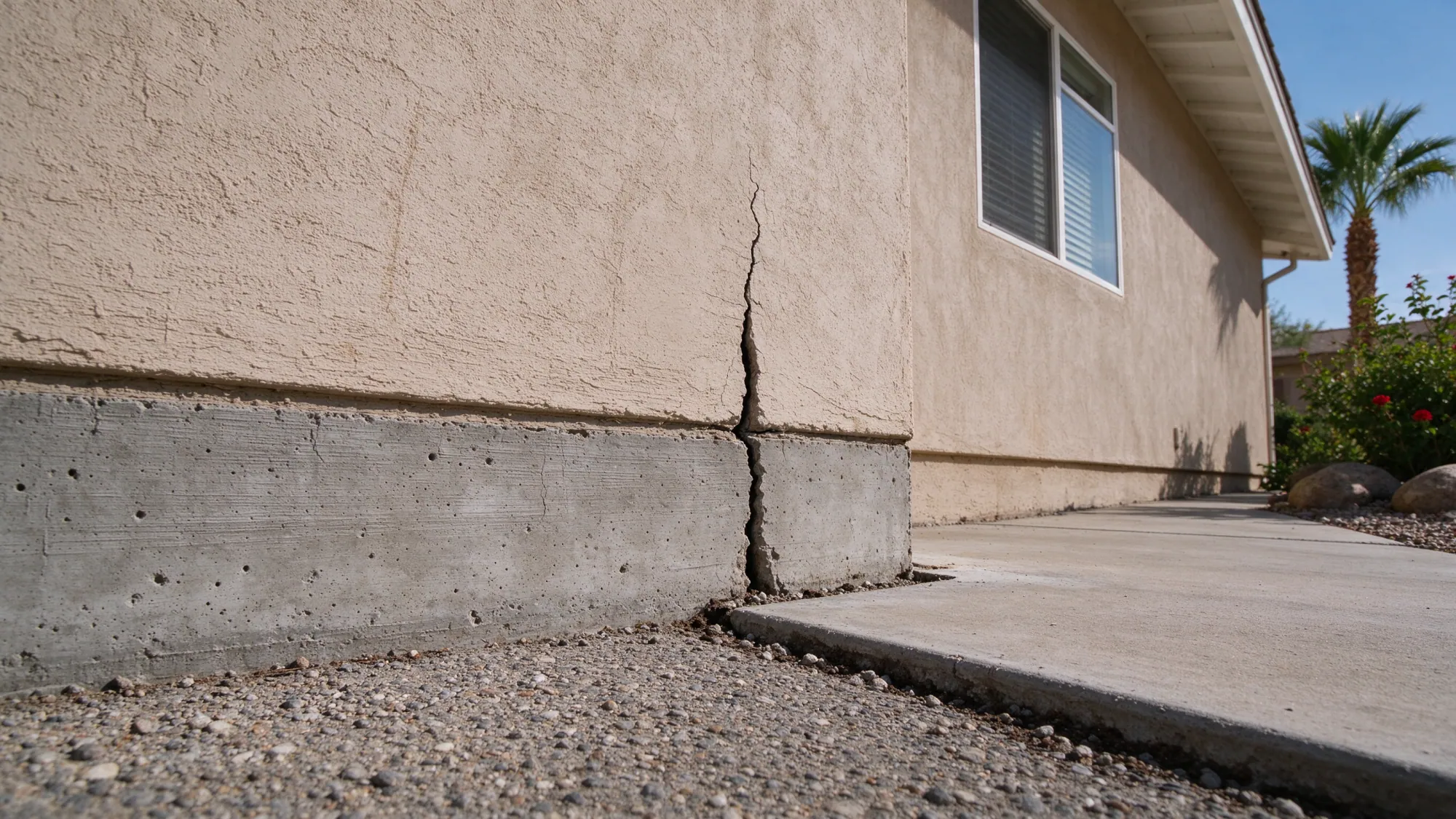
Insurance may cover some foundation-related damage, but the answer depends on the policy, cause of loss and supporting evidence. A crack or repair recommendation does not establish coverage. Valley Foundation Repair offers and manages residential and commercial foundation repair in North Las Vegas, fulfilled by licensed and insured contractors.
Treat the coverage question and construction question as connected decisions with different owners. The insurer reviews the claim. The responsible building and ground professionals establish the condition within their investigation scopes. The contractor prices defined work. Keeping those roles clear helps you avoid authorizing an incomplete repair on the assumption that someone else has agreed to pay.
Start with the cause, not the size of the crack
A visible foundation crack can accompany shrinkage, settlement, heave or deterioration. A new discovery during flooring work may reveal an older condition. Those distinctions matter to both the repair and the claim history. Record what you observed without choosing a cause simply because one explanation sounds more likely to be insured.
For example, a buried plumbing leak and an uneven floor are two observations. They may be related, but finding one does not prove the sequence or establish the extent of resulting damage. Plumbing investigation addresses the line. Structural and geotechnical evaluation address the building and support. An insurer may need those findings to understand what happened rather than relying on a photograph alone.
The water and foundation movement guide explains why repairing a leak and repairing support are separate scopes. Keep invoices and reports for both. A short label such as “water damage” may leave important questions about the affected materials and proposed work unanswered.
Read the actual policy and ask focused questions
Use your policy and endorsements, rather than a general online description of homeowners insurance. Ask the insurer which provisions apply to the reported condition, what documentation it needs and whether any decision remains pending. An exclusion, coverage limit or separate endorsement can change the result. This guide cannot determine how those provisions apply to an individual loss.
The Nevada Division of Insurance publishes consumer information and filed policy materials. Those resources can help you identify the kind of document you need, but another property’s policy is not your agreement. When asking a question, identify the damaged element and suspected event clearly enough that the answer addresses the proposed claim.
For a commercial property, confirm who holds the applicable policy and who can communicate about the claim. Building ownership, tenant improvements and business operations can involve different responsible parties. Don’t assume that a tenant’s report or a property manager’s repair request authorizes every part of the insurance or construction process.
Build a useful record before finishes hide the evidence
Take dated photographs that show the whole affected area as well as the visible defect. Note when you first observed a change, which doors or floors were affected and what work was underway. A chronology should distinguish a known date from an estimate. If you do not know when a crack formed, say when you discovered it.
Gather prior inspection reports, earlier repair proposals, available plans and information about leaks or drainage changes. Keep original reports intact so the scope and limitations remain visible. A report intended for a real estate inspection may recommend further evaluation rather than provide an engineered repair design. Do not present it as a conclusion it never made.
Ask what evidence must be retained before demolition or disposal. Safety and preventing further damage still need appropriate attention. If temporary measures are necessary, document the condition, the reason for the work and the party directing it. Establish with the insurer what authorization or records it requires instead of assuming that a later invoice will explain everything.
Define the next step for your property.
Share the property location, what you have noticed and any existing reports. Start with the concern so the assessment can be defined.
(725) 999-4951A repair scope must still address the physical problem
Insurance discussions do not change how building loads reach the ground. If the foundation has lost suitable support, a surface crack repair may leave that mechanism unresolved. If the issue is a suitable crack without continuing support movement, deeper structural work may not belong in the repair. The assessment needs to connect evidence to the method.
The initial project review considers the visible concern, access and existing records, then defines whether measurements, independent engineering or a soils investigation are needed. A single floor elevation survey can document relative levels without proving ongoing movement. The engineer and contractor assessment comparison explains the different questions each role answers.
Ask the contractor to identify work required for stabilization, any proposed lifting and separately priced finishes. An insurer’s allowance and a contractor’s scope may use different boundaries. Compare the actual tasks before treating two totals as directly equivalent.
Separate the claim decision from payment obligations
Before agreeing to construction, understand who is contracting for the work and what the payment terms require. An expectation of reimbursement is not the same as an insurer’s written decision. Avoid assuming that a contractor will carry the unpaid balance or that all later additions will be accepted as part of a claim.
Where concealed conditions may change the scope, ask how additional work is documented and authorized. The construction agreement should define the process for changes, and the insurer should explain what it needs to review any related claim item. Clear records reduce the chance that necessary work becomes an unexplained number added after excavation.
Use foundation repair cost guidance to understand the different planning units. A repair scope, a structural slab project and an installed pier are different things. Insurance questions do not make those units interchangeable or establish that every expense belongs in the same category.
Plan for occupancy and restoration as their own questions
An insurance review does not certify that every part of a building can remain occupied. If the condition or proposed support work affects an area, ask the responsible professional and contractor to define restrictions. A sudden major change or apparent loss of support calls for avoiding the affected area and seeking appropriate urgent help.
For scheduled work, identify access openings, utility precautions and disturbed surfaces before accepting the sequence. A foundation repair can leave flooring, paving or landscaping requiring separate restoration. The occupied repair planning guide can help organize those questions without promising that the whole building will remain available.
Keep the completion record with the claim file
Retain the written scope, approved changes, required inspection records and any installation logs or final measurements specified by the design. Keep a record of what was repaired and what remained outside the work. That information helps explain the completed construction to future professionals as well as to an insurer reviewing the file.
If the insurer’s answer is unclear, ask for the relevant decision and its basis in writing. If the construction recommendation is unclear, ask which investigation result supports it. Request a repair estimate with the property location and existing reports so those questions can be separated before you commit to the work.