
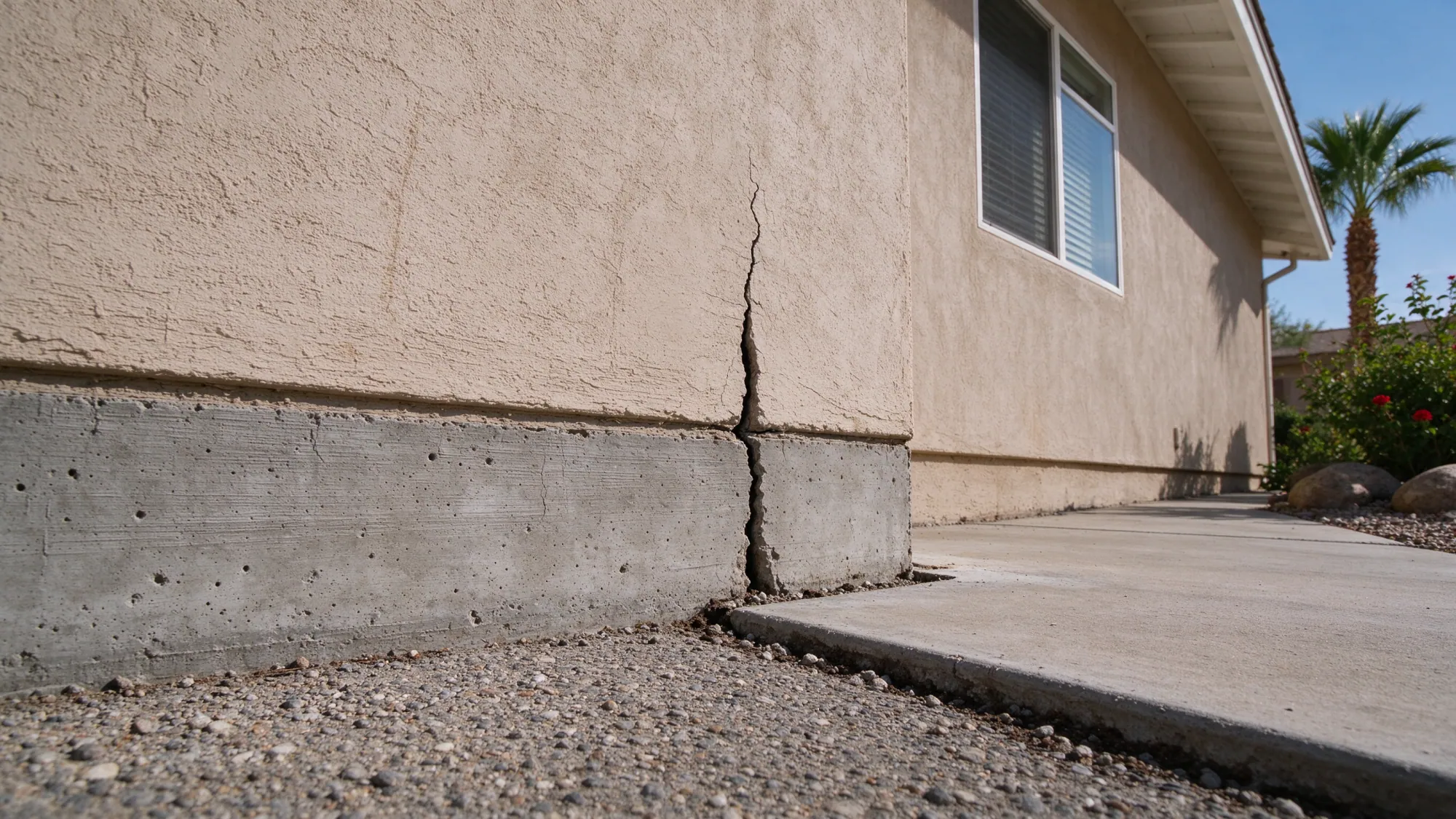
Caliche can make excavation or pier installation difficult, while collapsible soil can lose volume when wetted under load. Neither condition can be diagnosed from a neighborhood name or a surface observation. A repair needs ground information that distinguishes installation obstacles from bearing conditions and explains the movement affecting the building.
Valley Foundation Repair offers and manages residential and commercial foundation repair in North Las Vegas, fulfilled by licensed and insured contractors. Where ground conditions control the decision, the assessment defines the need for geotechnical investigation before the support method is settled.
What is the practical question when caliche is encountered?
Caliche is cemented ground material. Its hardness can affect excavation and the way equipment advances through the ground. That can change access, preparation and installation planning. It does not follow that any hard material encountered beneath a foundation is a continuous or suitable bearing layer.
Thickness and continuity matter. A hard layer at one location may differ elsewhere, and the material above or below it can still affect movement. The support design should establish which ground conditions it relies on, rather than treating resistance at one installation point as a complete explanation of the site.
The same distinction applies when an owner sees hard material in a utility trench. That observation may be worth recording, but it does not establish the footing depth, its actual bearing surface or the condition beneath a different part of the building. Ground information must be relevant to the foundation and repair area being considered.
How can wetting produce settlement instead of heave?
Some soils have a structure that can reduce in volume when wetted while carrying load. That wetting-related collapse differs from soil expansion, which can produce upward movement. Both involve moisture, but the direction of change and the design implications differ. “Water affected the soil” is not a sufficient repair diagnosis.
A source of water may alter susceptible material beneath only part of a building. The resulting differential movement can distort the supported structure. Establish the source, affected ground and structural response rather than assuming every nearby crack formed from the same mechanism.
Loss of support can also involve other conditions. Fill preparation, compression or movement of material may need investigation. The settlement versus heave guide explains why an uneven floor should not automatically lead to a lifting proposal before the ground and elevation pattern are understood.
What do soluble or chemically affected soils change?
Ground chemistry can raise questions about material loss, volume change or exposure of construction materials. These are not interchangeable conditions. Solubility, corrosive exposure and chemical heave describe different mechanisms, and a repair investigation should identify which question is relevant rather than placing all of them under a general “bad soil” label.
Clark County’s geotechnical provisions identify collapsible, soluble, corrosive and chemically affected ground among the conditions requiring attention within the applicable design context. That establishes useful regional questions. It does not prove the presence of those conditions at a particular property or transfer the county’s permit requirements automatically into North Las Vegas city jurisdiction.
Ask what testing or observations support the actual recommendation. The important output is how the findings affect bearing, materials, excavation and structural design. A list of soil terms without that connection leaves the owner unable to understand why the proposed repair is appropriate.
Define the next step for your property.
Share the property location, what you have noticed and any existing reports. Start with the concern so the assessment can be defined.
(725) 999-4951Why are maps and previous reports limited?
Regional soil maps provide an overview at their stated scale and scope. They can guide questions about a site but cannot establish the exact condition beneath one footing. Ground varies, and a mapped category is not an installation acceptance criterion. Avoid using a map color to choose a pier depth or treatment material.
An existing soils report can be valuable when it matches the property, construction phase and affected area. Review its date, scope and the conditions it actually investigated. Later grading, additions, utility trenches or repairs may introduce questions the original investigation did not address.
The guide to understanding a foundation soil report explains how findings and recommendations connect to design. Do not assume that possessing a report is equivalent to having the information required for the present repair. The responsible professional should identify what can be used and what remains uncertain.
What should geotechnical and structural roles establish?
Geotechnical work addresses the ground questions controlling bearing and movement. Structural evaluation addresses how the building carries loads and what the existing foundation or connection can do. The two scopes need to inform each other when a support repair depends on both the receiving ground and the condition of the building.
The investigation should be proportionate to a real decision. Ask which uncertainty it resolves and how a different result would change the design. An owner needs to know whether the report establishes a support condition, identifies a need for further work or leaves a concealed issue outside its scope.
A contractor’s construction proposal has a different purpose. It should explain the method and price within defined assumptions, while identifying the design and investigation responsibilities that support those assumptions. A fixed-looking price does not remove an unresolved bearing question from the project.
How do these findings affect underpinning and excavation?
Foundation underpinning needs a complete load path through the existing foundation, its attachment and the new support into suitable ground. Installation resistance can be part of a specified system’s criteria, but its interpretation belongs within that design. A hard obstruction is not a universal substitute for the required bearing condition.
Excavation beside an existing footing also changes the immediate support situation. Openings, temporary support and the work sequence need planning so information gathering or construction does not undermine the element being repaired. Utility and tendon locations must be considered before cutting or digging, rather than inferred from an apparently clear surface.
Restricted access can change the equipment or method available. Establish the route and work area before assuming a large rig can reach every support location. If conditions require a different construction approach, the proposal should explain how it achieves the same designed objective and what additional surfaces or areas it disturbs.
How should an owner compare the resulting proposals?
Compare the ground assumptions first. Two proposals may rely on different bearing zones, investigate different uncertainties or address different movement mechanisms. Their pier names or total prices cannot be compared meaningfully until those differences are understood. Ask each proposer to connect its method to the findings it uses.
Then compare installation criteria, required observations, permits and completion records. Access, removal of obstructions, utility precautions and restoration need named responsibility. If additional work can be required by concealed conditions, establish how it will be identified and authorized rather than leaving the trigger undefined.
Start a foundation settlement assessment with the available soils and construction records, photographs and water history. The aim is to establish which ground conditions matter to your building. Hard ground, wet ground and mapped ground each provide a different kind of information, and none should be asked to answer a question it cannot resolve.